The Asparagaceae are an economically and evolutionary important monocot (e.g., orchids, palms, grasses) plant group. It contains ~2,500 species which include iconic arid-adapted plants, such as the Joshua Tree (Yucca brevifolia) or the Dragon’s Blood Tree (Dracaena draco) as well as economically important species like asparagus (Asparagus officinalis), tequila agave (Agave tequiliana), garden hyacinth (Hyacinthus orientalis), and snake plant (Sansevieria trifasciata). There are huge differences in species richness and trait diversity across the Asparagaceae subfamilies, which makes the group excellent for studying both conserved and not-so-conserved trait evolution as well as how these differences influence diversification. For example, the Agavoideae contain ~650 species total, and have experienced multiple shifts from succulents/rhizomes to bulbs, whereas all taxa in the Scilloideae (1000+ ssp.) and Brodiaeoideae (~100 ssp.) have bulbs and corms, respectively. The Aphyllanthoideae only has one species in the whole subfamily: Aphyllanthes monspeliensis! The historical evolutionary processes generating the disparate biodiversity and morphological patterns seen across Asparagaceae are unknown. The Bulbous Lab aims to continually refine our understanding of the Asparagaceae phylogeny, from subfamilial relationships to species-level patterns, to better understand historical biogeography, trait evolution, and diversification of this diverse and important plant group.
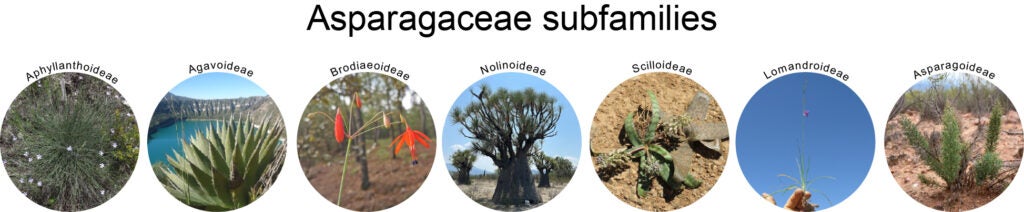
(photo credit: “Arthropodium fimbriatum plant1” by Harry Rose, CC BY 2.0); Asparagoideae—Asparagus alopecurus (Oberm.) Malcomber & Sebsebe (photo credit: Philip Bentz).