A new paper in Frontiers in Cognition by Maggie Doheny (ADDL PhD student), Dr. Nelson Roque (PSU), and Dr. Lighthall describes the complexities between trust, reciprocity, and perceptions of fairness in economic decision making.
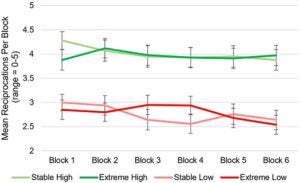
Using an adapted multi-round economic trust game, this study highlighted the effects of minimum and maximum offerings on both reciprocations and trust perceptions. Participants played the game with one “extreme” partner, who made a maximum or minimum offer, and one “stable” partner who did not. They played in either a high or low offer condition, where all offers from the stable partner were above or below the median amount, respectively. Each partner was actually a computer program, although participants were made to think that they were playing with another user in real time.
Findings showed that while extreme-high partners did receive slightly more reciprocations than stable-high partners, the difference in the proportion of reciprocations was minimal (only 1.66%). This lack of difference supports the idea that extreme amounts do not create a major impact on reciprocation when all offers are above the median amount or “fair.” As predicted, the stable-low partner received more reciprocations than the extreme-low partner. Ratings of trust followed a similar pattern. Extreme-high partners received higher trust ratings, but only by a negligible amount. In the low condition, however, trust ratings were significantly higher for the stable partner.
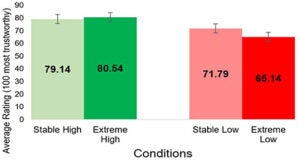
These results align with Prospect Theory in that minimum offers have a greater impact on both behavior and perceptions than equivalent gains (maximum offers). Ultimately, this study displays the lasting impact of extreme actions on trust, with extreme betrayal weighing more heavily than extreme generosity.
For access to the paper: