
Vatican Astronomer Visits America’s Space University
Brother Guy J. Consolmango, S.J., astronomer and president of the Vatican Observatory Foundation, shared insight on astronomy, exploration and scientific discovery during his recent visit to UCF.
Written by: Emily Dougherty | Published March 31, 2026
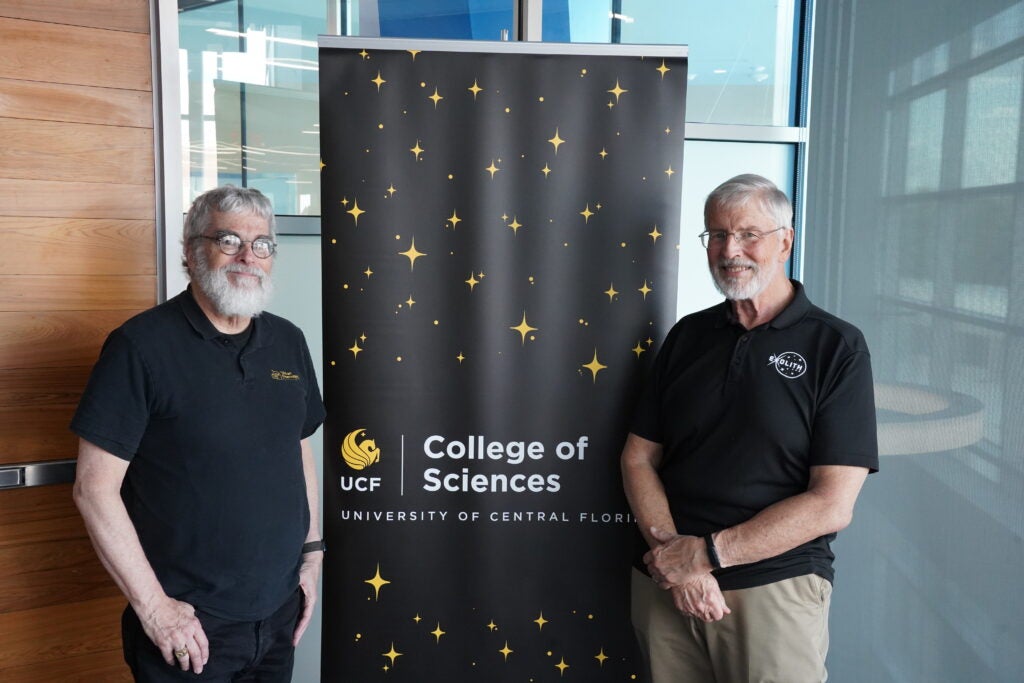
Whether on the campus of America’s Space University or at one of the oldest active astronomical observatories in the world, scientific discovery is shaped both by new ideas and the people who pursue them.
UCF students, faculty and researchers had an opportunity to learn from a Vatican Observatory astronomer, Br. Guy J. Consolmagno, S.J., on his recent visit to Orlando. Drawing on his work as a researcher and president of the Vatican Observatory Foundation, Consolmagno connected lessons from the past with the realities of modern science, highlighting the enduring nature of human curiosity about the cosmos.
“We look at the sky and we wonder where we fit,” he says. “That question belongs to everyone.”
Special Guest Lecturer
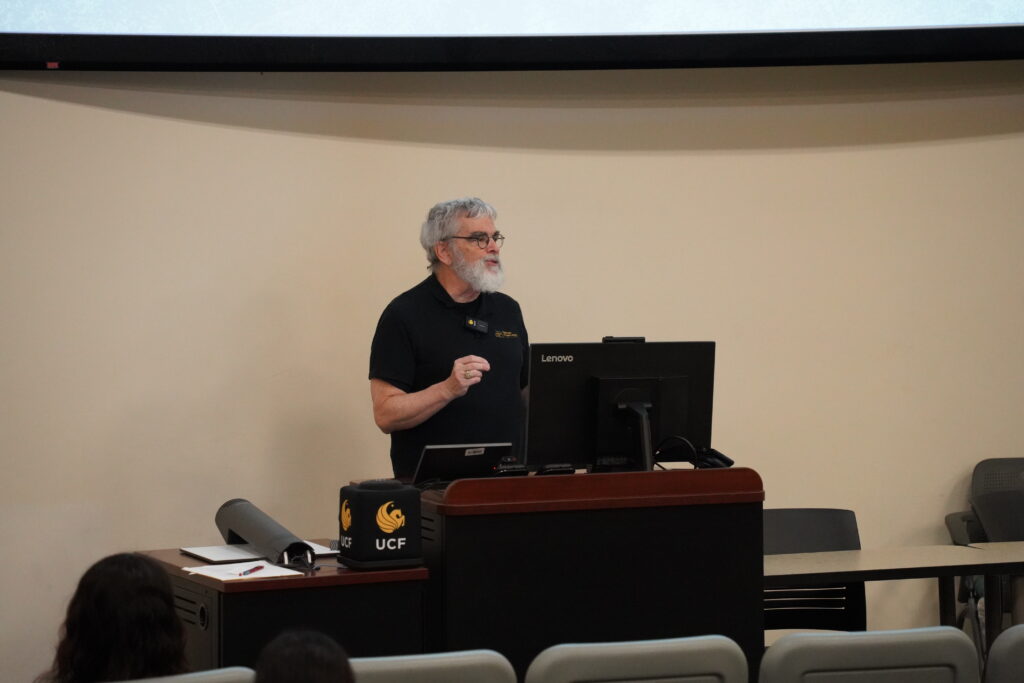
During his visit to an Introduction to Astronomy class, Consolmagno spoke with students about the life and work of Italian astronomer Galileo Galilei, focusing on the historical context of his discoveries and the challenges scientists faced during that time. He explained how Galileo’s observations of the night sky, including the motion of planets and the phases of Venus, helped change the way people understood the universe.
Throughout the lecture, Consolmagno emphasized that the history of science is a gradual process shaped by curiosity, new tools and the willingness to keep asking questions.
“Science doesn’t move forward all at once,” he says. “It moves step by step, as people learn to see things in new ways.”
He also discussed how Galileo’s work showed the importance of observation and careful measurement, explaining that early telescopes allowed scientists to gather evidence that had never been possible before.
“Once you can observe something for yourself, the conversation changes,” he says. “You’re no longer arguing about ideas — you’re looking at what’s actually there.”
From MIT to the Vatican Observatory
In his afternoon talk, Consolmagno also shared some of his backstory that led to his career in space, relatable to many students at UCF – the No. 1 supplier of talent to the nation’s aerospace and defense industries. His interest in astronomy began early, inspired by the space race and the first satellites launched into orbit. By the time he reached college, he was certain he wanted to study the universe, eventually earning advanced degrees in planetary science and building a career in research and teaching.
But his path was not a straight one.
At one point, unsure about his future in academia, he joined the Peace Corps and moved to Kenya, where he taught science and rediscovered his love for astronomy while sharing the night sky with students.
Looking up at the familiar constellations from the equator changed his perspective.
“If I can see the stars I know I’m not away from home,” he says.
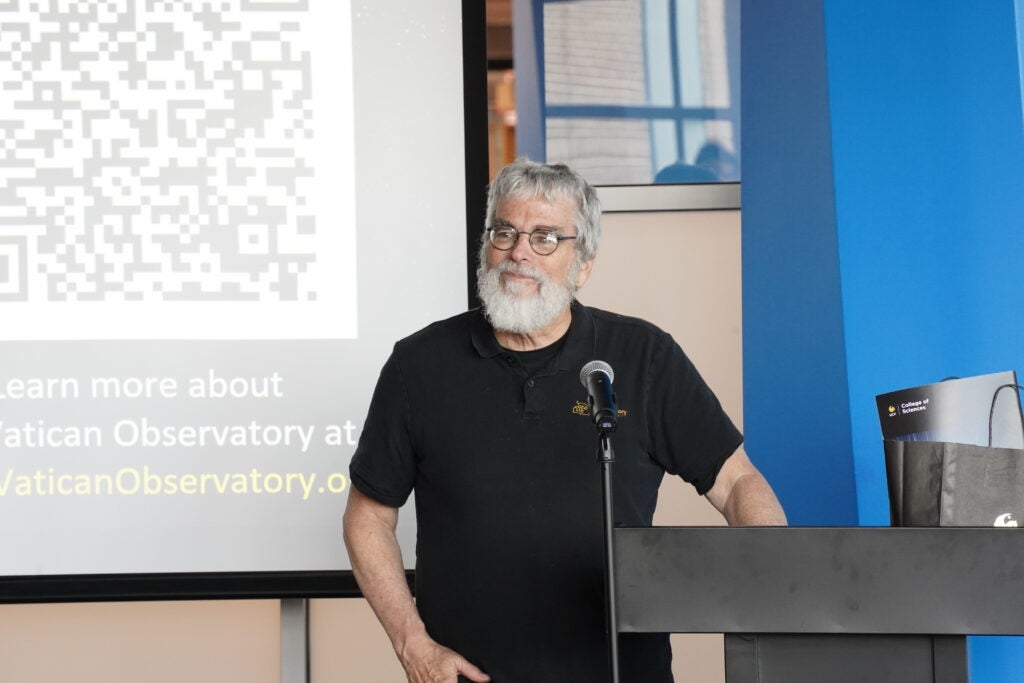
He joined the Vatican Observatory in 1993, where he has spent decades studying meteorites, asteroids and planetary materials while working within a religious community dedicated to scientific research.
Founded in the 16th century and formally established in its modern form in 1891, the observatory was created to show that the Catholic Church supports scientific discovery. Today, its researchers — including UCF physics alum Brother Robert Macke ’10PhD — work on projects ranging from telescope development to planetary science.
“The church founded the observatory to show that faith and science are not enemies,” he says. “We’re not here to prove God with a telescope. We’re here to understand the universe as honestly as we can.”
His research has taken him to observatories in Arizona, laboratories around the world and even Antarctica, where he joined expeditions searching for meteorites under extreme conditions and in some of the most remote places on Earth.
Those experiences, he says, reinforced the idea that science is not only about knowledge, but about the human desire to explore.
“We look at the sky and we wonder where we fit,” he says. “That question belongs to everyone.”
Wonder, Curiosity and the Human Connection
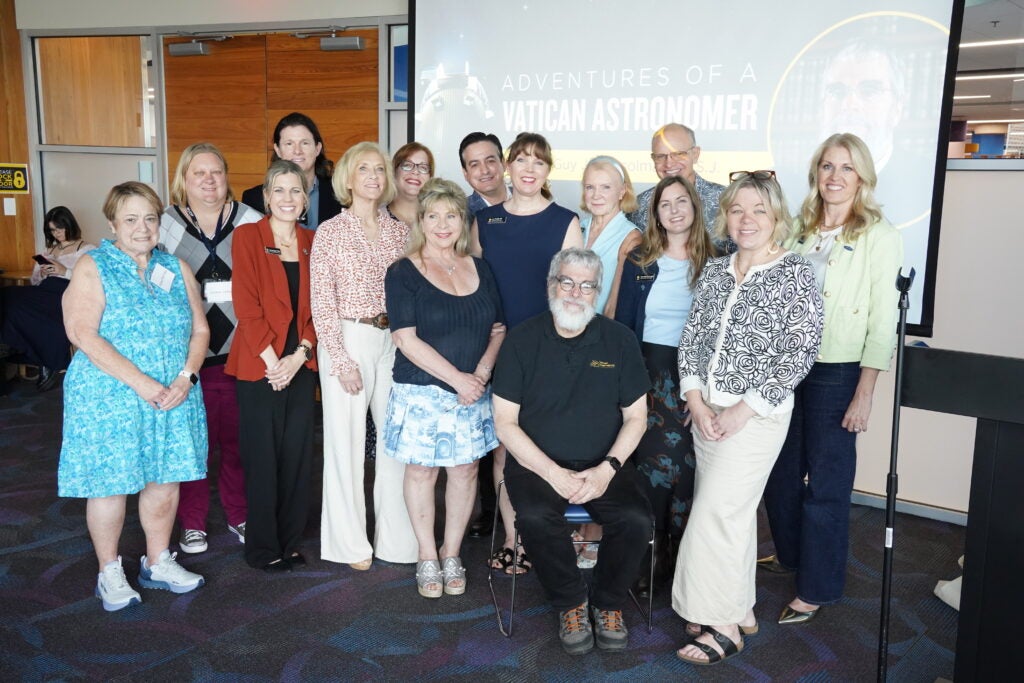
Throughout the lecture, Consolmagno returned to the idea that both science and faith begin with the same impulse — curiosity about the universe and our place in it.
In the end, his message to students was simple: follow your curiosity, take chances and don’t be afraid of unexpected paths.
“Astronomy is not just the study of stars and planets,” he says. “It’s the study of human beings trying to understand the universe and that’s the greatest adventure of all.”