Inaugural Gilson Lecture Series Features Oxford Professor on How the Senses Shape Perception
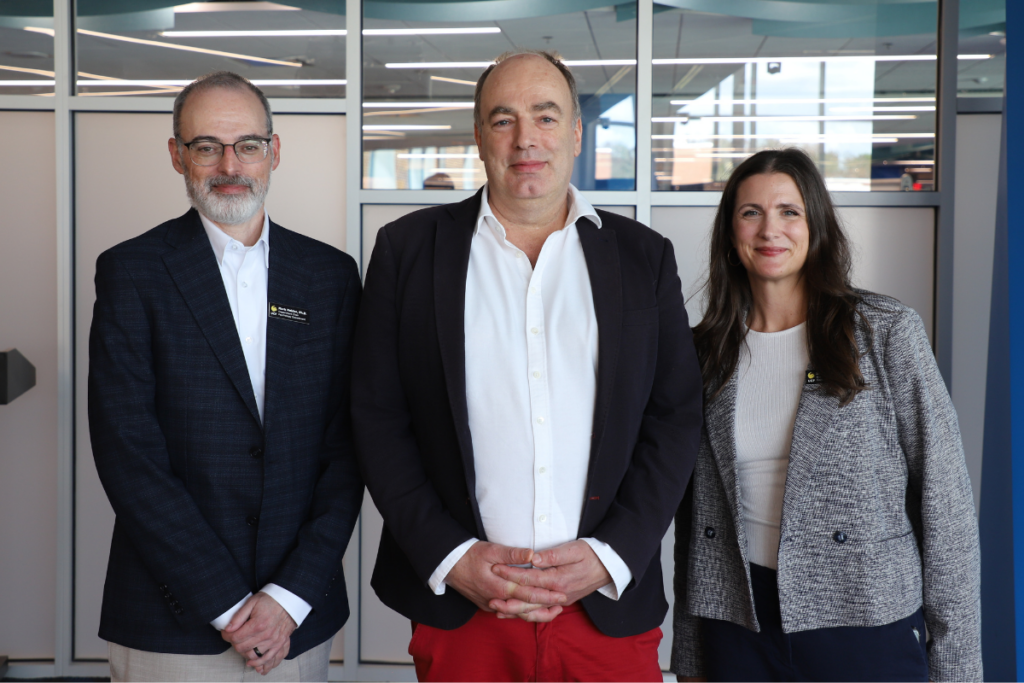
The UCF Department of Psychology hosted its first Richard Gilson distinguished lecture series, featuring University of Oxford professor Charles Spence, who explored how the human brain integrates sensory information and how those connections are shaping research, design and real-world experience.
Written by: Ana Hidalgo and Shaloni Prine | April 21, 2026
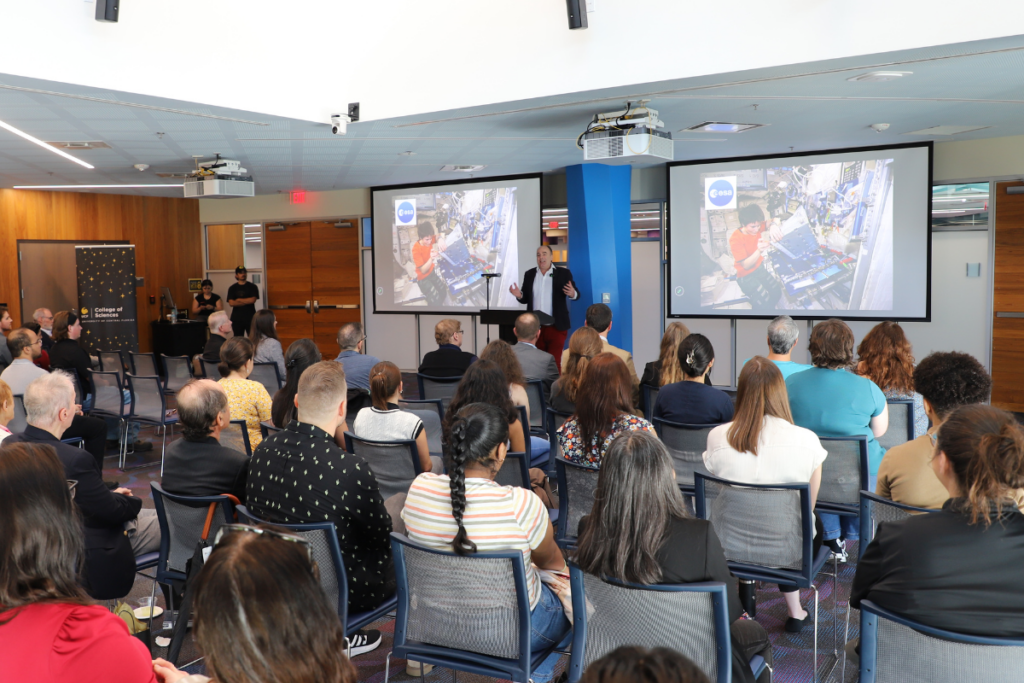
On April 3, 2026, the UCF Human Factors and Cognitive Psychology Program hosted the inaugural Richard Gilson Innovation in Multimodal Information Processing (MIP) Distinguished Lecture Series, a donor-sponsored event named in honor of UCF Professor Emeritus Richard Gilson.
The series highlights innovations in technologies and research that explore how the brain integrates information across multiple senses and how these insights inform fields such as artificial intelligence and design to improve the interpretation of complex information. It also connects psychological insight with technological advancement, underscoring that meaningful innovation depends on understanding human behavior and cognition to develop technologies that are impactful, ethical and beneficial.
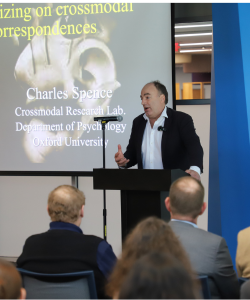
The inaugural lecture featured Professor Charles Spence, a world-renowned experimental psychologist from the University of Oxford, who presented Connecting the Senses Across Time and Space: Crossmodal Correspondences in Science, Art, and Design.
A Legacy of Research and Mentorship
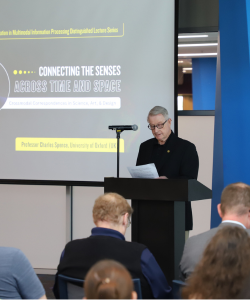
UCF College of Sciences Interim Associate Dean of Research and Facilities Nichole Lighthall opened the program introducing Professor Emeritus John “Jack” McGuire, who shared remarks on Gilson’s legacy of research and influence at UCF.
“Dr. Gilson’s research spanned a wide range of cross-disciplinary scientific and engineering fields, including information processing, simulation and training, and alert and warning systems, with applications in aviation, military, and healthcare domains,” McGuire says.
McGuire also shared that, as a true academic and Renaissance man, Gilson made significant contributions, but his most notable impact was on students at UCF.
“As the founder of the Ph.D. program Human Factors and Cognitive Psychology, he laid the foundation for decades of doctoral graduates who have made their mark in industry, government and academia,” he says.
An Unexpected Path to Multisensory Research
Spence opened his lecture by tracing the origins of his work, sharing how an unexpected undergraduate experience set him on a path toward studying multisensory perception.
“My lifelong fascination with this field of research began after I encountered a DJ with a broken television whose mismatched sound and visuals revealed the brain’s remarkable ability to fuse conflicting sensory cues,” he says. “This experience sparked my interest in applied science and ultimately led me to explore how the brain integrates information across the senses to guide real-world behavior.”
Spence noted that as technology evolved—from radio and television to smartphones and touchscreens—it has increasingly engaged more of our senses.
“For the past 15 years, we’ve been adding senses,” he says. “For the first few years, it was just hearing and vision. Then, in 2000, we added touch and as the years go by, we’re creating a multisensory picture.”
Building on that progression, Spence says his work now focuses on understanding what connects the senses and how that alignment can be used to design more intuitive and immersive experiences, interfaces, and forms of entertainment.
Crossmodal Correspondences
As the lecture shifted, Spence challenged long-standing efforts to link the senses in predictable ways. He explained that for centuries, artists, scientists, and musicians have tried to translate color into sound or sound to color. Yet those attempts rarely agree.
“The fact that they disagree means we’re still none the wiser about how to try and translate one sense into another,” he says.
Instead, he introduced the concept of crossmodal correspondences, which are shared, intuitive associations people make across the senses.
“They’re the common tendency we all have to match features or attributes in one sense with those in another,” Spence says.
Unlike personal or subjective associations, which vary from person to person, these correspondences are consistent.
“Audiences, for example, tend to associate sweetness with softer, higher-pitched sounds and bitterness with sharper, more angular ones,” he says.
To demonstrate this, Spence played a series of audio clips, asking guests to match each with different taste profiles.
He then pointed to real-world applications, sharing how restaurants and companies are using these principles to shape how people experience food and drinks.
“By finding the corresponding notes and timbres to tastes and flavors, we can dial them up without using words,” Spence says.
He cited a study to illustrate how context can shape perception.
“At an experiential event, approximately 3,000 attendees were asked to rate their wine as the room’s colors and sounds changed,” Spence says. “Many reported that the flavor seemed to change, with some saying that the sensory environment ‘totally changed’ their taste perceptions.”
The Future of Multisensory Design
Spence concluded his lecture by pointing to a future where these insights increasingly shape design across industries, from dining and entertainment to technology and health.
“In the healthcare sector, this research could help address a key challenge for cancer patients: reduced appetite and food aversion during chemotherapy,” he says. “These side effects can hinder proper nutrition and slow recovery. By restoring appetite and improving the enjoyment of food, this work highlights how advances in multimodal information processing can enhance patient care and outcomes.”
More broadly, Spence adds that rather than treating the senses as separate channels, designers can create more intuitive and immersive experiences by understanding how they work together, ultimately transforming the landscape of multisensory experience and interface design.
Department of Psychology Interim Chair Mark Neider closed the event thanking Gilson and the donor for making the event possible, as well as Spence for an insightful talk.
“We hope you enjoyed this thought-provoking talk by Dr. Spence,” he says. “His exploration of how our senses interact, and the ways these connections shape everything from research to real-world experiences, is a powerful reminder of the kind of innovation happening across our fields.”