
Cinematography Master Class Pushes UCF Film Students to Embrace Collaboration and Creative Limits
The head of the cinematography department at New York University’s Tisch School of the Arts Graduate Studies shares with students how filmmaking grows through limitation, teamwork and experience.
Written by: Emily Dougherty | Published: April 27, 2026
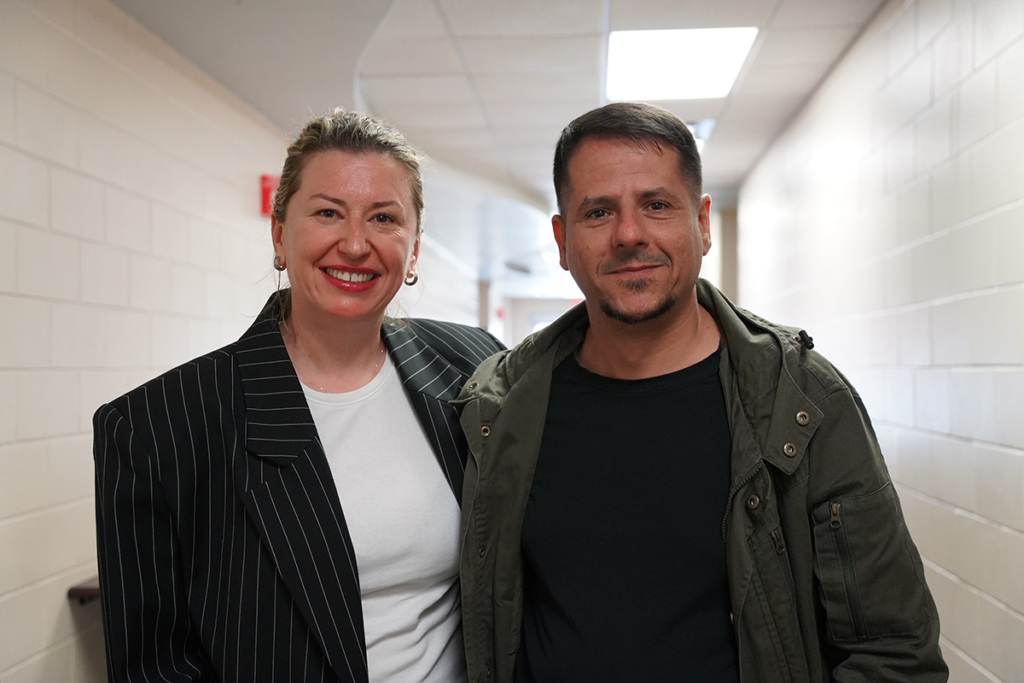
Students in the Nicholson School of Communication and Media (NSCM) film program gained an inside look at the realities of filmmaking with Tatjana Krstevski, head of the Department of Cinematography at New York University’s (NYU) Tisch School of the Arts Graduate Studies.
Invited by visiting NSCM film instructor Dragan Vildovic, a longtime friend and fellow filmmaker, Krstevski met with students for a master class to share both technical insight and hard-earned lessons from her journey behind the camera. Her visit was a full-day event that included a screening of Asleep in My Palm, for which she served as cinematographer, as well as a master lecture on color in cinematography.
From the beginning, she emphasized that filmmaking is not about mastering a single role, but understanding how every piece comes together.
“What I love is that it’s called filmmaking,” Krstevski says. “Students get a chance to explore all the different disciplines. It’s teamwork. It’s merging all these beautiful art forms.”
Building on that theme, Krstevski took the time to have each student introduce themselves while sharing their major and career interests. She followed met with each student individually, offering advice and encouraging them to explore other aspects of the arts to strengthen their creativity.
Krstevski’s own path reflects that philosophy. She began in visual arts by studying drawing, painting and graphic design before discovering cinematography as a way to translate that visual instinct into film. Growing up in Serbia during a time shaped by war, she says those experiences influence both her perspective and her work.
“I was always the girl with the camera,” she says. “I wasn’t aware that I was already doing it.”
After studying at the University of Belgrade with Vildovic, Krstevski built her career by working in camera departments and shooting as many projects as possible, often saying yes to every opportunity that come her way.
“I worked on every shoot that came to me,” she says. “Every time somebody calls, you say yes. That’s how you build experience.”
That mindset is one of her central messages to students: experience comes from doing, not waiting.
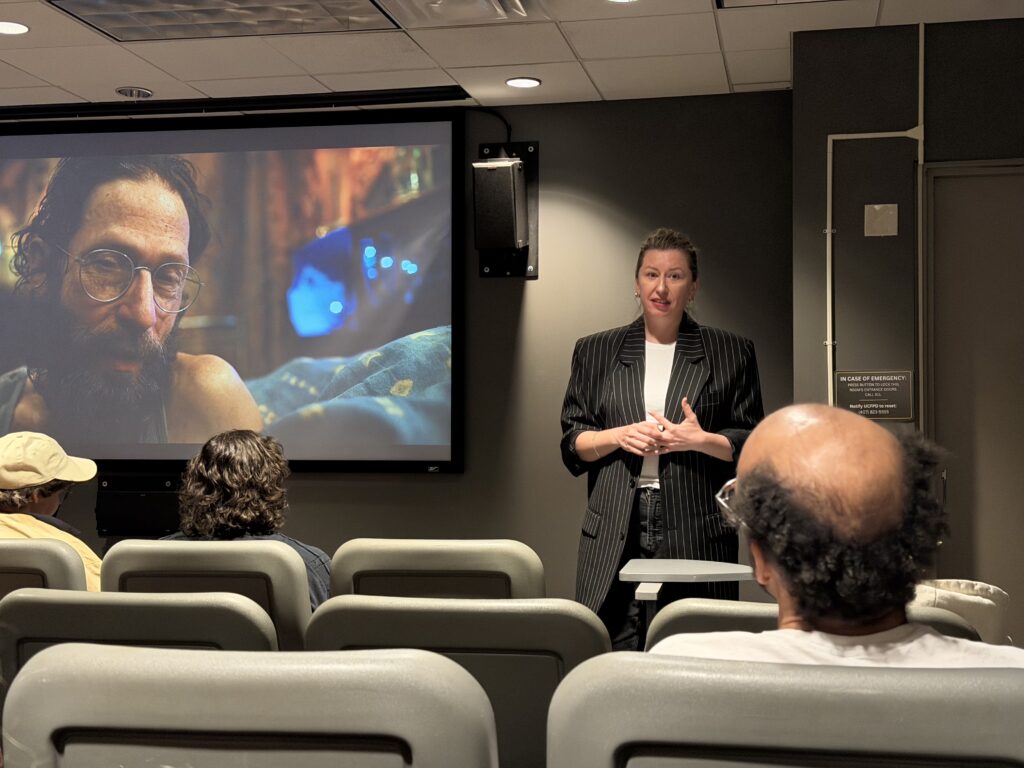
“Fail—and you’re failing by doing,” Krstevski says. “You need to do as much as possible so you can learn from it.”
She also stressed that film school itself is a unique yet limited window that students should take full advantage of.
“This time will never repeat,” she says. “The whole point is to collaborate with as many people as possible. The people you work with now are the same people you’re going to continue working with in your career.”
Throughout the session, Krstevski returned to the importance of collaboration, describing it as the foundation of filmmaking. She encouraged students to build relationships, contribute to each other’s projects and develop strong collaborative habits early.
Beyond collaboration, Krstevski challenged students to rethink how creativity works. Rather than seeing limitations as obstacles, she frames them as essential tools.
“The more you limit yourself, the better the product will be,” she says. “There is some paradox about it, but it’s true.”
Drawing from her own experience shooting a feature film in just 15 days with a limited budget, she explains how constraints shape every creative decision, from camera choice to lighting approach.
“All the creative elements come from the limitation,” she says.
Krstevski also emphasized adaptability as a critical skill. Whether adjusting to unexpected conditions on set or navigating changes in post-production, she describes filmmaking as a constant process of responding in real time.
“You have to prepare yourself so nothing can surprise you,” she says. “But at the same time, know it will change and be okay with that.”
She compared the process to movement and rhythm, a recurring theme throughout her talk.
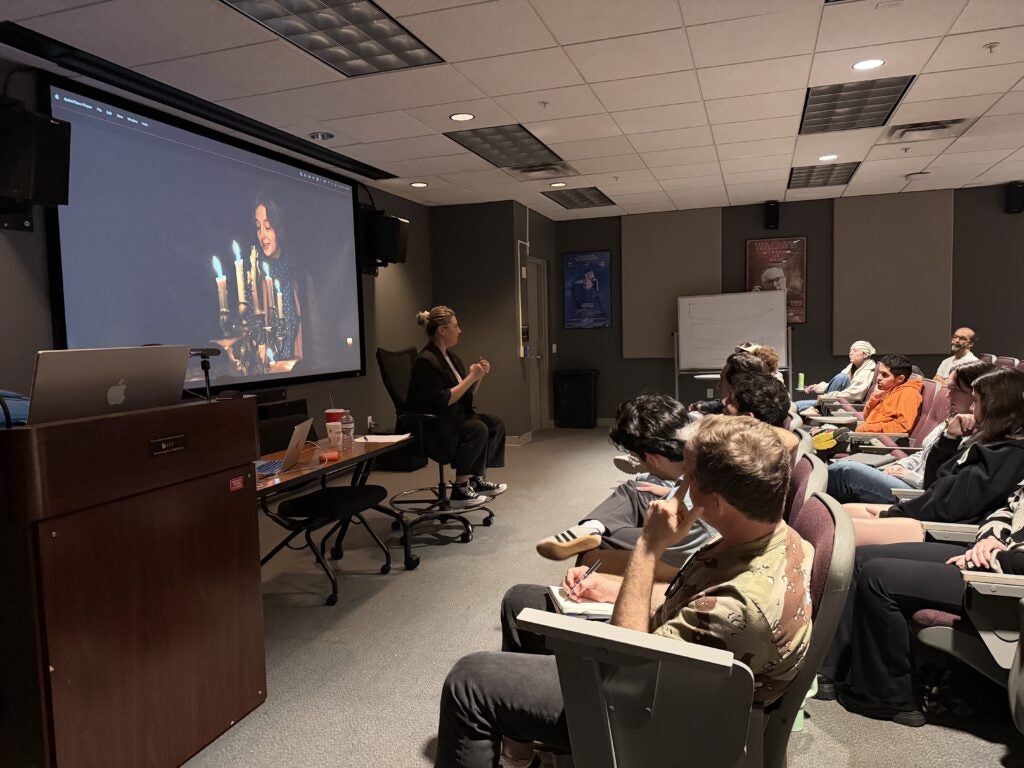
“You have to learn how to dance,” she says. “Things will not go your way. You need to adapt.”
Her technical advice reinforces that philosophy. From using minimal lighting setups to embracing natural sources such as the sun, Krstevski encourages students to focus on fundamentals rather than relying on expensive equipment.
“You don’t need a lot to achieve great things,” she says.
She also urges students to experiment—whether through documentary work, camera movement or visual style—highlighting how hands-on practice sharpens instincts and builds confidence.
“Shoot as much as you can,” she says. “That’s how you craft your skills.”
By the end of the master class, Krstevski left students with a clear takeaway: filmmaking is not just about technical mastery, but about mindset—one rooted in curiosity, resilience and collaboration.
“Open yourself and enjoy it,” she says. “Enjoy the ride.”