
Fulbright Experience in Uzbekistan Opens Doors for Future Global Collaboration
College of Sciences professor’s Fulbright Specialist experience lays the foundation for future collaboration in artificial intelligence, data science and international academic exchange.
Written by: Emily Dougherty | Published: July 24, 2026

When Hsin-Hsiung “Bill” Huang, professor of statistics and data science, traveled to Uzbekistan this spring as part of the Fulbright Specialist Program, the visit represented far more than a short-term teaching appointment. The project created new opportunities for international collaboration, expanded UCF’s visibility in emerging areas of artificial intelligence and data science and strengthened the university’s role in global academic engagement.
Hosted by Al-Khwarazmi University (AKHU) from April 20 to May 29, 2026, the Fulbright Specialist project, “Machine Learning and Advanced Filtering Techniques,” focused on machine learning, data science, statistics, Python computing, reproducible research and advanced computational methods. Through lectures, workshops, computer lab sessions, mentoring and faculty discussions, Huang worked directly with students and faculty eager to strengthen AKHU’s growing capacity in artificial intelligence and data science.
The experience also highlighted how international academic exchange can directly benefit UCF. By building relationships with faculty and students in Uzbekistan, the project opened pathways for future collaboration in research, virtual seminars, student mentoring, curriculum development and faculty exchange. Huang says these partnerships help position UCF as an internationally connected institution with expanding research opportunities abroad.
“One of the most important aspects of the project was helping students and faculty see themselves as part of the global research community,” Huang says. “At the same time, it created opportunities for UCF to build meaningful academic relationships in a region with deep scientific and mathematical traditions.”
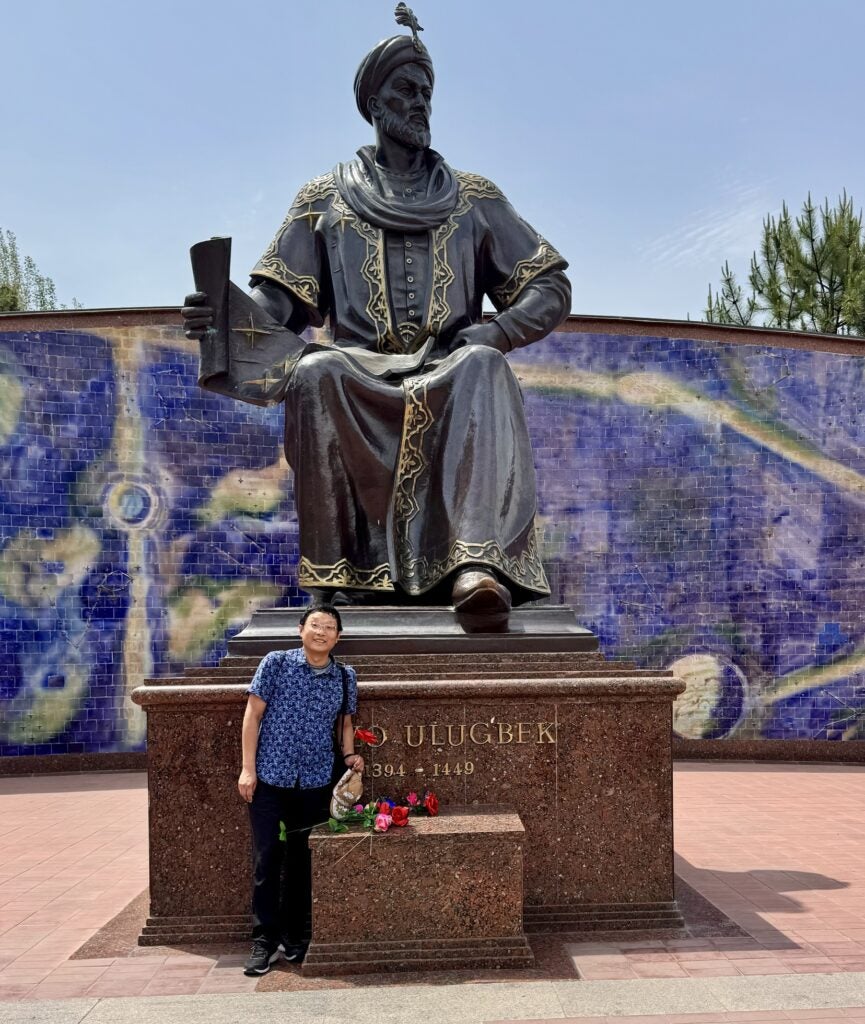
That connection between historical scientific heritage and modern computational research became a central theme throughout the visit. AKHU is named after the mathematician Muhammad al-Khwarizmi, whose work helped lay the foundations for algebra and algorithmic thinking. Visiting historic Silk Road cities such as Samarkand and Bukhara reinforced the broader significance of the project for Huang, whose work focuses on statistics, machine learning and data science.
“AI and data science are often described as entirely new fields, but they are connected to a much longer human story of mathematics, observation and discovery,” Huang says. “Uzbekistan’s scientific heritage provides an important context for understanding the future development of artificial intelligence and computational research.”
The Fulbright project also introduced students and faculty at AKHU to broader elements of U.S. research culture, including evidence-based problem solving, reproducibility, peer review, academic publishing and scientific communication. Huang emphasized that strong research depends not only on technical tools, but also on systems that allow knowledge to be tested, shared and refined over time. In particular, he shared how research at UCF is built around investigating new questions, mentoring graduate students, publishing papers, collaborating internationally and participating in conferences and seminars.
For UCF students, he says experiences like this also reinforce the increasingly global nature of artificial intelligence and data science. International collaboration, cultural awareness and cross-cultural communication are becoming essential skills for students preparing for careers in globally connected scientific and technological fields.
“AI and data science are global disciplines,” Huang says. “Students entering these fields will increasingly work with international teams, global datasets and problems that cross national boundaries. Academic exchange helps prepare students for that reality.”
The project also demonstrated the value of Fulbright and public diplomacy programs in strengthening relationships between universities and countries. During the visit, Huang engaged not only with AKHU, but also with the U.S. Embassy in Tashkent and broader educational and cultural exchange activities.
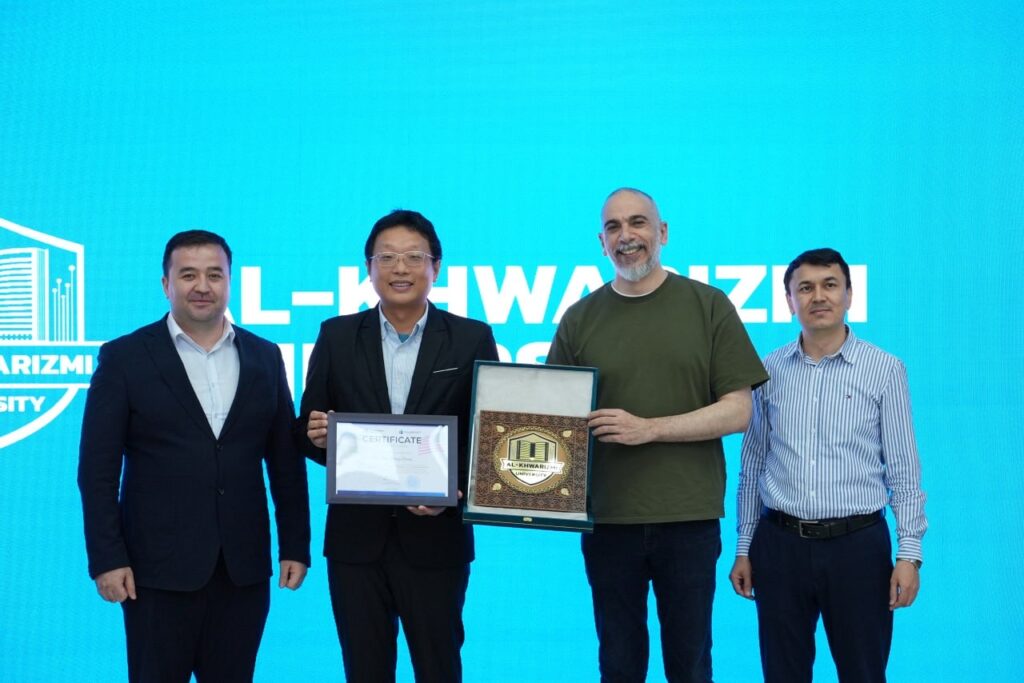
Informal conversations with students and faculty became some of the most meaningful moments of the experience. Outside the classroom, discussions expanded beyond machine learning and statistics to include graduate education, research careers, academic publishing and life in the United States. Those conversations helped build trust and deeper human connections that strengthened the academic exchange itself.
According to Huang, the enthusiasm shown by AKHU students and faculty revealed strong potential for long-term collaboration between the institutions.
“I hope this project will be remembered not only as a completed Fulbright Specialist visit, but as the beginning of continued academic connection between AKHU and UCF,” Huang says.
As UCF continues expanding its global research profile, experiences like this demonstrate how international academic exchange can strengthen research partnerships, broaden cultural understanding and help prepare students and faculty to engage with the future of global science and technology.