
UCF Researchers Travel to South Pacific for Diving Research Expedition
Led by a UCF faculty member, a global team of researchers is using innovative genetic analysis to uncover how countless drifting fish larvae connect distant reefs.
Written by: Emily Dougherty | Published: February 6, 2025
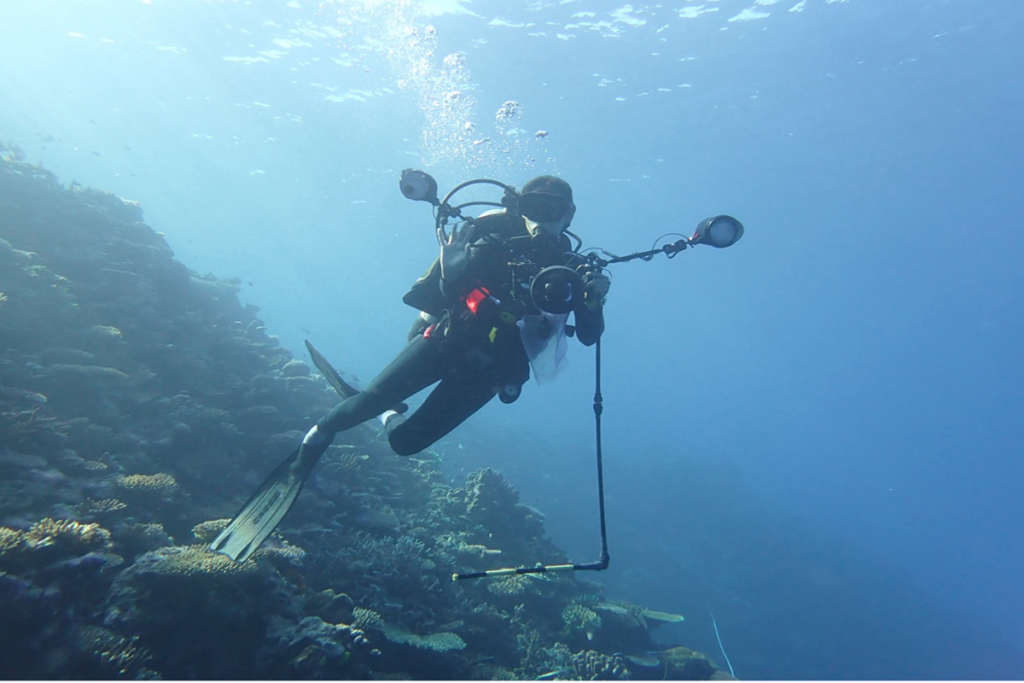
Countless larvae move through the ocean currents every day, and UCF researchers are taking a closer look at how these larvae travel and keep distant reefs connected. Led by Associate Professor of Biology Michelle Gaither, DisKer (Dispersal Kernel), a collaborative research project that examines the movements of these tiny larvae, utilizes innovative genetic and oceanographic modeling methods. Its success is rooted in partnerships with researchers that span across continents. Together, they are working to track these connections and strengthen the understanding of how reefs across the Pacific are connected by dispersal.
With funding from the National Science Foundation, her research group traveled to the South Pacific this past summer to work with local community members, scuba divers, and an interdisciplinary group of researchers from France, New Caledonia, Vanuatu, Fiji, and the United Kingdom.
How UCF Leverages Global Research Partnerships
UCF Postdoctoral Researcher and Marine Biologist, Melanie Heckwolf, says that understanding how far fish larvae disperse can help us understand our larger ocean ecosystem.
“Up to millions of larvae are released into the ocean and move with the ocean currents until they settle on a reef, sometimes hundreds of kilometers away from their parents,” Heckwolf says. “Their spatial distribution is an important metric for our basic understanding of marine ecology and evolution as well as for management and conservation of marine resources.”
She shares that the DisKer project is groundbreaking due to its size and its genetic approach.
Historically larval dispersal kernels are often studied through the use of computer models,” Heckwolf says. “There are very few empirical measurements of marine dispersal kernels due to the cost and infeasibility of current genetic tagging methods.”
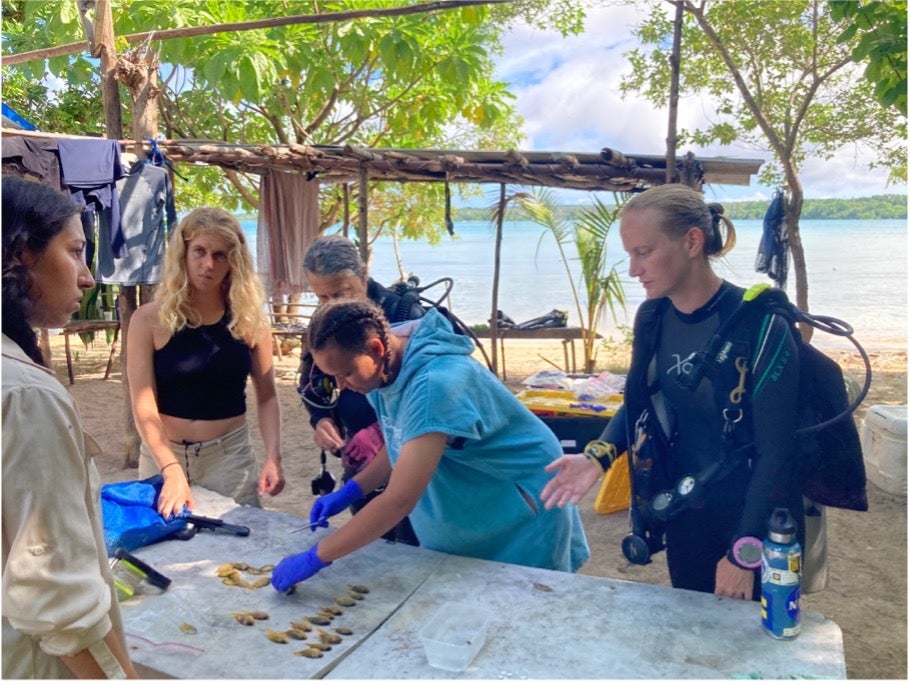
Heckwolf explains that tracking these tiny larvae has posed challenges, but the team has come up with a clever solution.
“When imagining a dispersal kernel of countless tiny eggs, or tiny fish larvae that are transparent, it becomes easy to understand how hard it may be to follow them through the ocean for hundreds of kilometers,” she says. “To date, less than ten species across just five seascapes have been assessed with [parentage-based] methods. DisKer’s approach offers a clever workaround. Rather than looking for fish larvae or eggs directly, we sample adult fish from different reefs and genetically determine their migration patterns. This helps to answer the question ‘Where are the offspring of these parents going?’”
DisKer uses an indirect approach based on population genetics to track larvae, allowing the team to estimate dispersal patterns across three archipelagos and seven reef-fish species. According to Heckwolf, this strategy significantly reduces the cost, time and effort of sampling, while producing high quality data for reef connectivity and dispersal.
Collaboration and Community Involvement
Heckwolf says that fieldwork for the project relied on deep collaboration with local communities.
“Without the local knowledge of where to find our target species, the support of local fishers in catching fish and the help of the fisheries departments, this project would not have been possible,” she says.
This research project benefits from the global collaboration of scientists whose shared insights significantly impact their work.
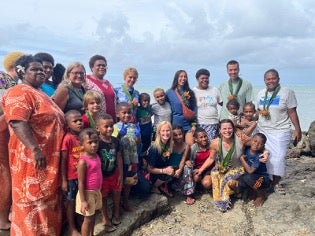
“DisKer has a large, interdisciplinary and international team, which includes researchers from the United Kingdom, United States, Australia and the South Pacific, along with community involvement from the areas where we have conducted research,” Heckwolf says. “Our work was made possible by working with French researchers in New Caledonia and fisheries officers in Vanuatu and Fiji. We spent a lot of time presenting our work to local communities to gain their support and obtain permission to work on the local reefs.”
“Later in the project we will host a workshop and present our data to the respective fisheries departments. The goal of our collaboration is to use the data we produced to inform resource management and conservation decisions.”
UCF’s Growing Scientific Diving Program
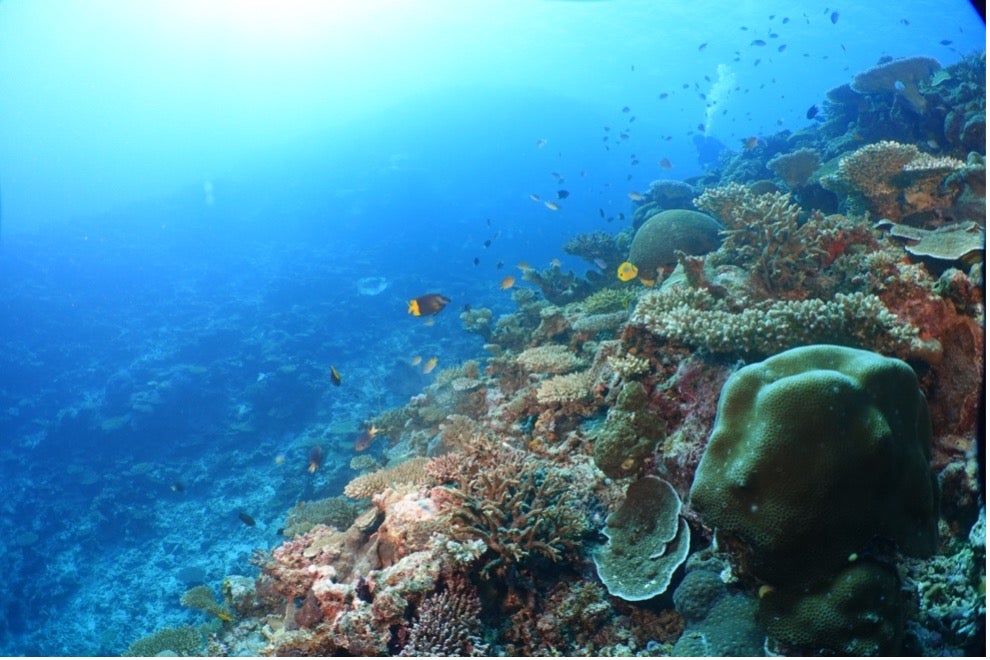
Gaither says UCF involvement wouldn’t have been possible without the UCF Scientific Diving Program.
“Prior to 2020 there was no mechanism at UCF to regulate scuba diving as a research activity. Now, through the UCF dive program, we can support underwater research for students, faculty, and staff. While most dive-related research opportunities are focused in Florida, we’ve supported research expeditions to the Caribbean, Eastern Pacific and across the Indo-Pacific,” Gaither says.
Since its launch, the program has trained 66 UCF Divers including graduate students and facultymembers across an array of disciplines including biology, environmental science, and engineering. Moreover, as a program they have logged over 1200 dives with zero safety incidents.
Carrying Forward a Legacy of Student Research Opportunities
Doctoral student Ella Adams-Herrmann says working on the DisKer project with a team of international researchers has given her the opportunity to gain experience outside of the classroom.
“Being part of the DisKer research has been the best outcome I could have asked for,” she says. “I have been able to work in the field with some really inspiring professors, postdocs and grad students.”
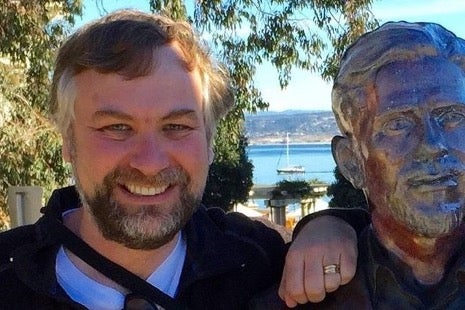
Gaither says the DisKer team is influenced by the legacy of the late Dr. Eric Crandall, a biology professor from Pennsylvania State University.
“He was the inspiration behind the project and was essential in getting everyone together and obtaining the funding,” Gaither says. “His intelligence, kindness and commitment to local community involvement have inspired and accompanied us throughout our expedition. The team is committed to conducting the project in the way he had envisioned it.’