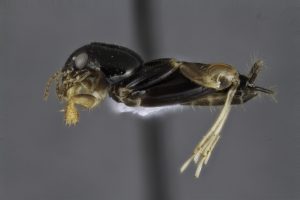
 Technically a pygmy mole cricket (Orthoptera: Tridactylidae) in (or near) the species Neotridactylus archboldi Deyrup & Eisner, these beasts spend most of their lives in subterranean burrows in dry sandy habitats, feeding on the layer of algae in the soil crusts a few millimetres below ground. They do come to the surface during the wet season after rains. For more info see Deyrup 2005
We collected this specimen in a pan trap in sandhill habitat at the fall 2018 bioblitz. This is noteworthy because these flightless orthopterans have until recently only been known from a few sites on the Lake Wales Ridge. This specimen represents a disjunct and probably genetically distinct population.
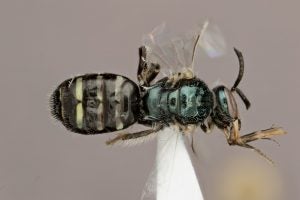 Perdita floridensis is a mining bee (Hymenoptera: Andrenidae) found in the Southeast that is only out as an adult for about a month in mid-spring. As a juvenile it lives in nests in the sand below seasonal ponds where it is completely submerged under water for several months. To cope with this inundation, females coat pollen pellets in a water repellent substance when stocking their nests for their young, and larvae also secrete a water-repellent substance. For more info see Krombein et al. 2003
We collected this specimen in a Malaise trap in pine flatwoods habitat during the spring 2018 bioblitz.