
College of Sciences Hosts Interdisciplinary Seminar on Avatars, AI and the Future of Human Performance
Interdisciplinary seminar highlights how UCF faculty are leveraging AI technologies and immersive systems to transform communication, teaching and embodied experiences.
Written by: Emily Dougherty | Published: February 27, 2026
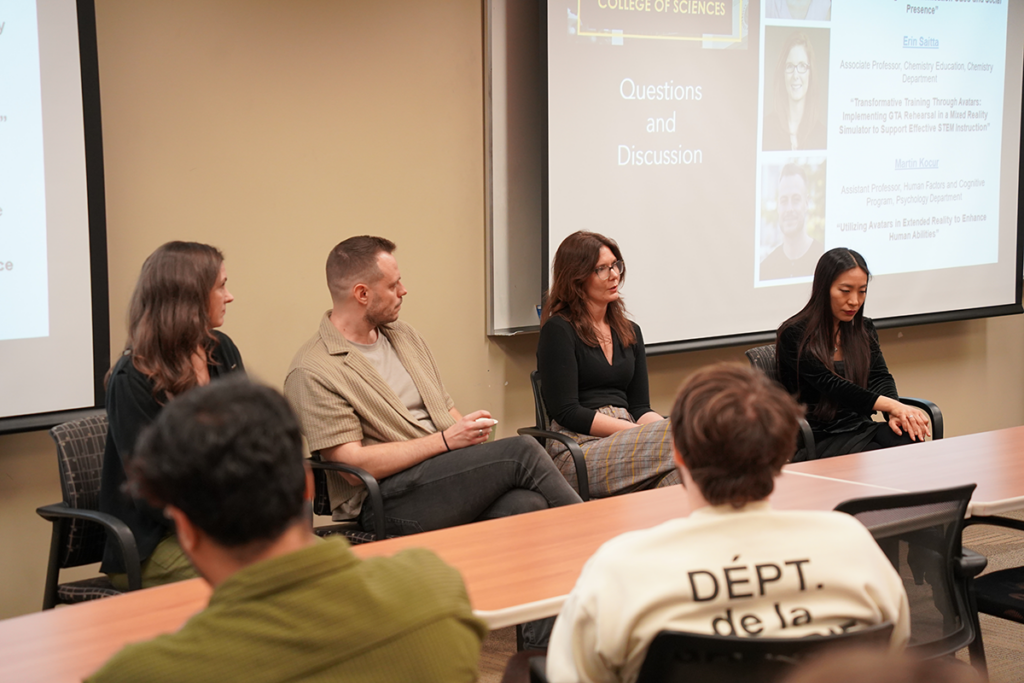
As artificial intelligence and immersive technologies continue to evolve, researchers across the College of Sciences (COS) are investigating how digital agents influence the way people communicate, learn and even experience their own physical abilities.
To advance cross-interdisciplinary research and collaboration, Interim Associate Dean of Research and Facilities Nichole Lighthall, convened faculty from communication, chemistry and psychology for a seminar titled “Avatars and AI Virtual Agents in the Sciences: From Basic Perceptions to Performance and Learning Applications.” The event explored how avatar-based systems and AI-driven agents are reshaping human behavior across various contexts.
Designing Social AI
Jihyun Kim, professor in the Nicholson School of Communication and Media, studies human-machine communication (HMC), focusing on how people perceive and interact with AI agents as communication partners. Her work draws from social presence theory, which examines how mediated entities, whether machines or human, can evoke feelings of connection and relational closeness.
“When we communicate with an agent — whether it’s a robot, embodied AI or voice-based AI — we form social perceptions of them, just like we do with human beings,” Kim says.
In experimental studies of AI instructors, Kim manipulated communication styles in virtual lectures. When the AI adopted a relational, socially expressive tone rather than a strictly task-oriented delivery, students reported stronger feelings of social presence and more favorable attitudes toward the AI instructors.
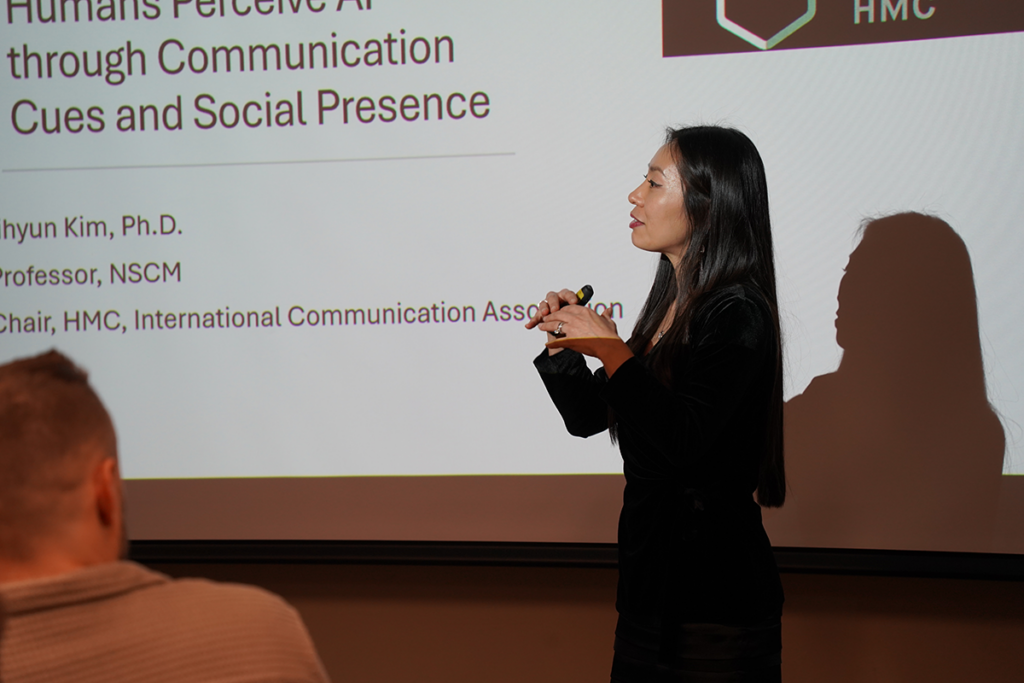
“When the machine teacher uses a relational communication style, students feel stronger social presence that leads to more favorable attitudes toward the machine teacher,” Kim says.
Her research also extends to AI social companion platforms designed to simulate friendship or a romantic partnership. Even when users understand they are engaging with an algorithm, many experience genuine emotional connection.
“People do not always see this technology as just an algorithm. They see it as another social partner,” Kim says.
Rather than centering her work on whether these AI systems should exist, Kim’s work focuses on improving how they are designed and deployed to produce positive outcomes, with particular attention to their social and behavioral impact.
“We live with these technologies. The question is not whether they should exist, but how we should design them to improve communication,” she says.
Practicing Teaching in a Virtual Classroom
Erin Saitta, associate professor in the Department of Chemistry, examines how avatar-based simulation can support graduate teaching assistants as they develop evidence-based instructional skills in STEM classrooms.
Despite decades of research supporting active learning, many new instructors struggle to implement interactive techniques, particularly those that increase student participation but may also raise anxiety, such as cold calling.
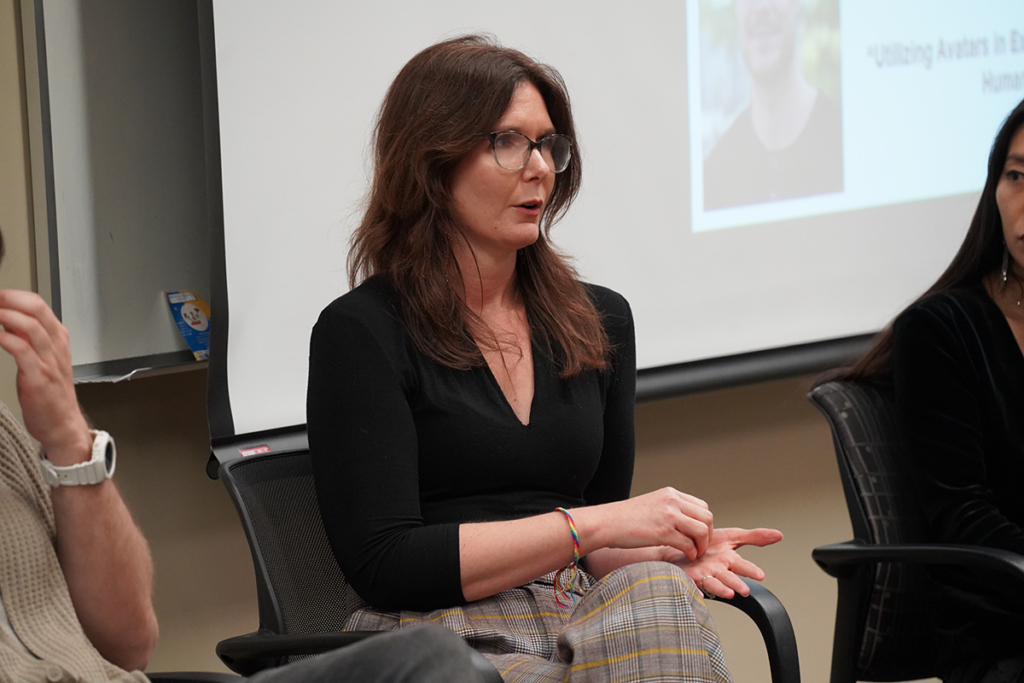
To address that gap, Saitta uses a human-in-the-loop teaching simulator originally developed at UCF. In the system, graduate instructors teach avatar students who are controlled in real time by a trained interactor, allowing them to rehearse specific strategies and refine their instructional skills in a realistic environment.
“This is an authentic but low-risk training space. They can practice the skill without the pressure of a live classroom,” Saitta says.
Rather than simulating entire lectures, the training focuses on discrete pedagogical moves, such as pairing cold calling with error framing, a strategy that normalizes mistakes to reduce student apprehension.
“Cold calling can increase participation, but it also increases anxiety,” Saitta says. So, we pair it with techniques that reduce apprehension.”
By building scenarios around documented student misconceptions, the simulator mirrors authentic classroom challenges. Saitta’s team measures how teaching assistants perform in the simulator and whether those skills transfer into their real classrooms.
“If we give graduate teaching assistants information and resources, and a space to rehearse, they can demonstrate resilience in their professional development,” she says.
Embodying Enhanced Performance
Martin Kocur, assistant professor in the Department of Psychology, investigates how immersive virtual reality and avatar embodiment influence self-perception and measurable performance.
In one line of research, Kocur shares how participants embodied avatars with enhanced muscularity while performing physically demanding tasks. Those represented by more muscular avatars reported lower perceived exertion.
“Just by embodying an avatar represented with enhanced physical abilities, we reduced perception of effort,” Kocur says.
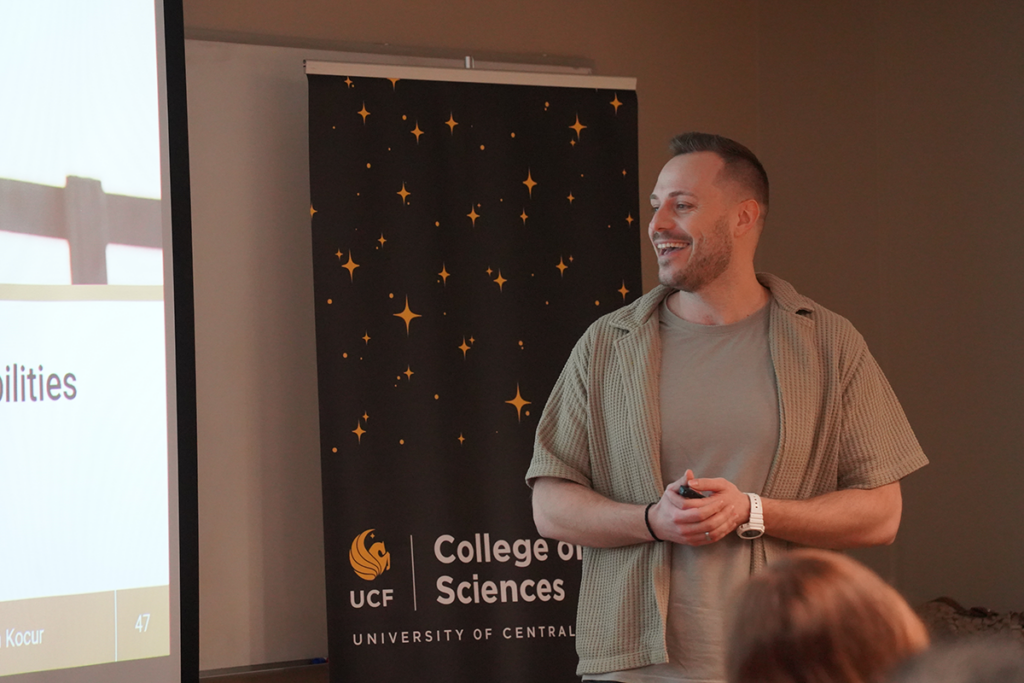
Follow-up experiments extended the findings to physiological outcomes. Participants cycling as athletic avatars exhibited lower heart rates compared to those embodied in less athletic representations.
“We could replicate the reduction in perceived effort,” he says, “and we also found a significant effect on heart rate.”
Kocur has also explored whether embodying figures associated with intelligence affects cognitive performance and motivation. While direct cognitive improvements were not consistently observed, he says that motivational shifts emergedwhen participants shared virtual space with an intelligent counterpart.
“There seems to be a trend that sharing a virtual space with an intelligent counterpart may influence motivation,” Kocur says.
Looking ahead, Kocur sees broad potential for the use of immersive technologies in combination with virtual avatars.
“There are significant opportunities to advance our understanding of how altered self-perception can be strategically utilized to improve physical performance, cognitive performance, and well-being,” he says.
A Shared Inquiry Across Disciplines
While rooted in different theoretical frameworks and methodologies, each piece of research points out a central insight that digital agents are not neutral interfaces. They are social and psychological environments that shape how people think, feel and perform.
As AI systems become increasingly embedded in everyday life, the seminar emphasized the importance of examining not only their technical capabilities, but their human consequences.