
College of Sciences Inspires Curiosity at Spark STEM Fest
Through hands-on activities and demos, the College of Sciences connected its research with the Central Florida Community.
Written by: Ryan Fox | Published: February 27, 2026
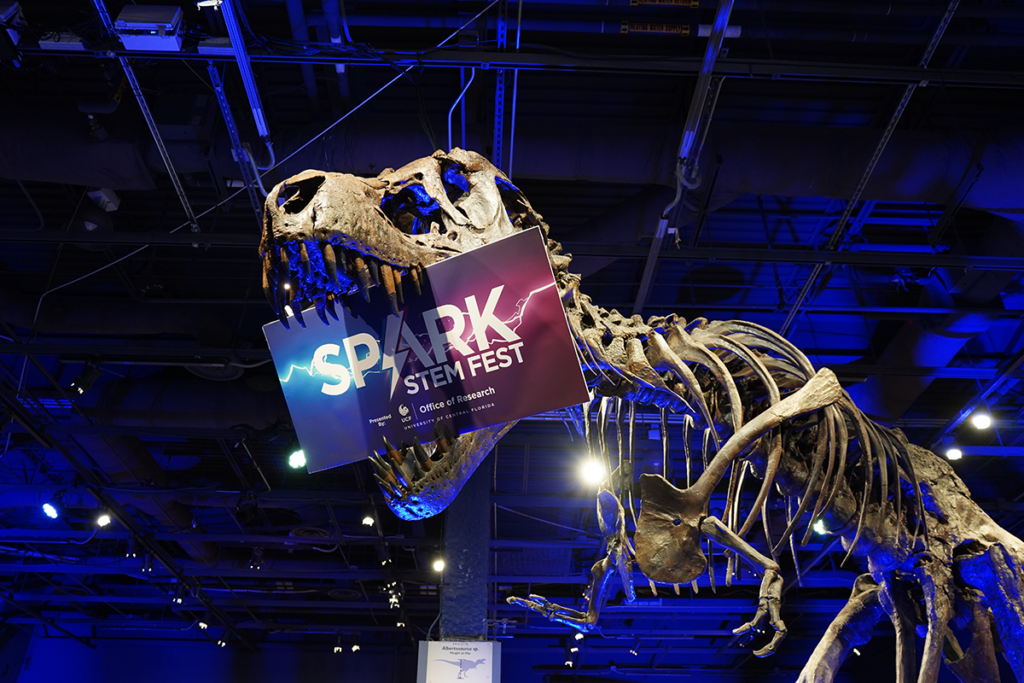
Innovation met curiosity as the College of Sciences (COS) engaged future scientists, alumni, and the Central Florida community at Spark STEM Fest.
Presented by the UCF Office of Research, Spark STEM Fest is an annual celebration of technology and innovation held at the Orlando Science Center to inspire future generations of scientists. The event brings together researchers, students and community members for hands-on exhibits and demonstrations designed to showcase real-world discovery and inspire the next generation of STEM leaders. Through these experiences, attendees explored a variety of scientific fields and gained a deeper understanding of how research shapes the world around them.
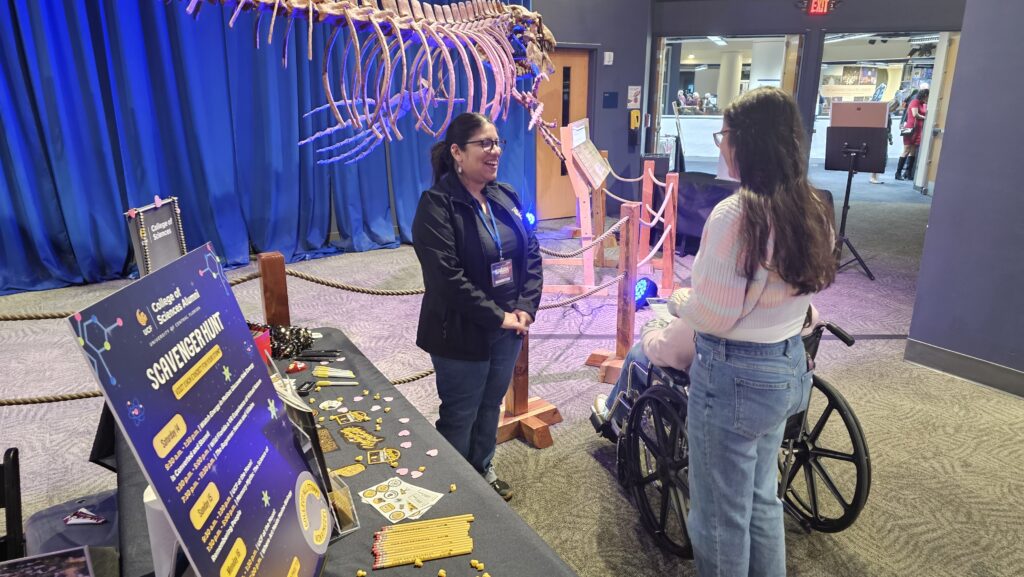
COS brought seven different exhibits over the three-day event, showcasing research across both physical and social sciences. This variety of exhibits demonstrated that science comes in many different forms while still being fun and engaging.
Kicking off the weekend was Associate Professor Dr. Mihai Vaida from the Department of Physics with his exhibit, “Watch Energy in Motion: Discover How Energy is Converted and Stored.” Through a variety of interactive displays, Vaida and his team demonstrated how different types of energy can be transformed and stored in everyday systems, from batteries and motors to renewable energy.
“By focusing on interactive and visually engaging experiments, the exhibit allows young audiences to explore STEM principles actively, ask questions, and see science in action,” he says. “This approach sparks curiosity, builds confidence, and encourages excitement about science and engineering in a meaningful and memorable way.”
In the afternoon, visitors stepped into a virtual tour of the UCF Arboretum with “Wild Florida: A VR Experience of Virtual Nature,” presented by Dr. Maria Harrington, associate professor in the Nicholson School of Communication and Media.
Her exhibit immersed attendees in Florida’s natural landscapes, showcasing real plants and ecosystems. Each plant was modeled for botanical accuracy, and the ecosystem was populated with species in a way that reflects its natural environment, giving participants the most accurate representation.
“At its core, the exhibit is about connecting people to nature through immersive learning,” Harrington says. “My biggest hope is that they leave with a sense of awe and wonder. If a child says, ‘Wow, I didn’t know nature was this cool!’ then I’ve done my job.”
In the evening, the Department of Biology invited visitors to explore the tiny organisms around us through their demo, “The Bugverse: Heroes and Villains,” presented during Science Night Live, an adults-only event.
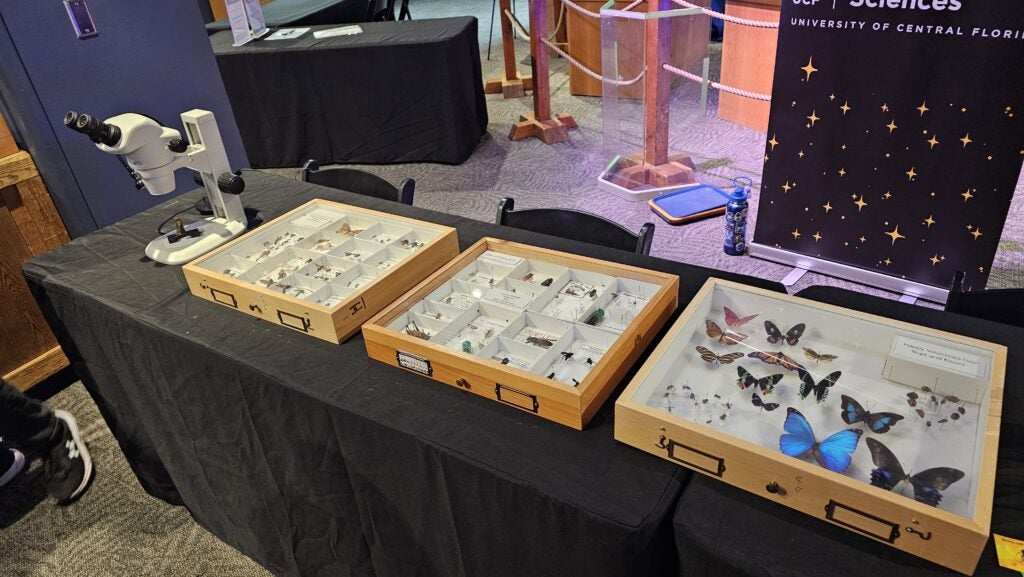
Through microscopes and display cases, attendees explored a variety of familiar pest insects and their natural enemies, including parasitoid wasps.
Reflecting on her favorite moments presenting this type of exhibit to the public, Dr. Barbara Sharanowski, professor of biology, says she loves seeing the surprise and curiosity in people’s reactions.
Sunday started with a look at our not-so-distant celestial neighbor with the Department of Physics’s presentation, “UCF at the Moon!” led by Associate Professor of Physics Dr. Kerri Donaldson Hanna.
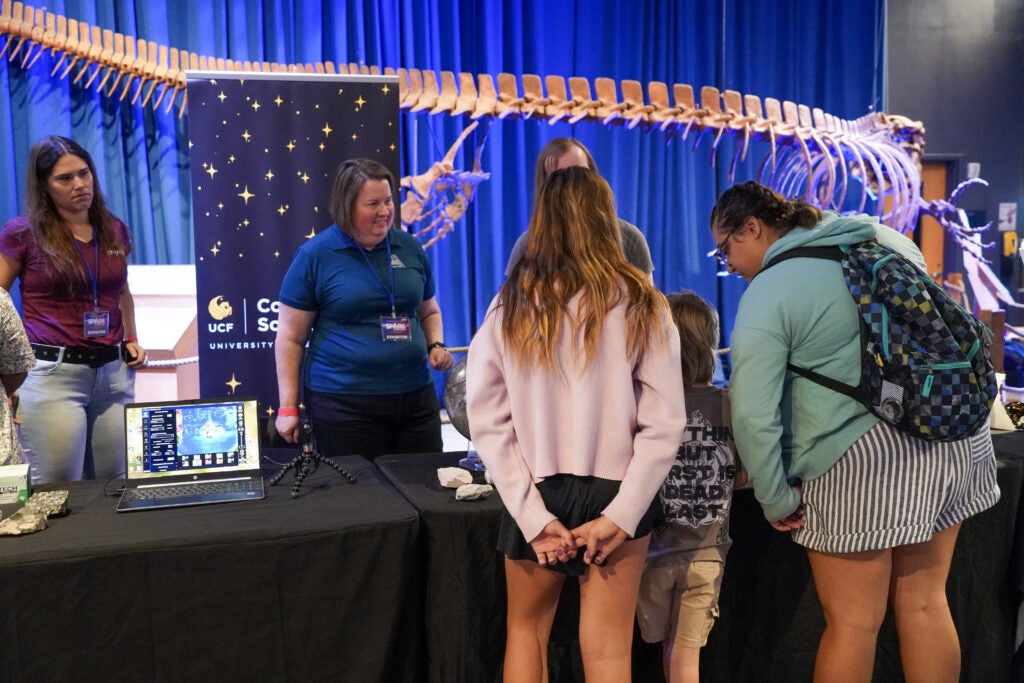
Visitors got a detailed look at the moon with a lunar globe and familiarized themselves with the types of rocks and minerals found on the lunar surface using representative samples. They also gained insight into how scientists can learn about the materials present on distant stellar bodies using a field spectrometer to see how each material reflects sunlight.
She says she wanted visitors to see that there are things around us on Earth that remind us of other planetary surfaces.
“The rocks that we have here today are from Earth, but they are similar to those that we would find on the moon,” Donaldson Hanna says. “By linking the two, visitors have a little reminder about things they could see in space in their everyday lives.”
In the afternoon, Assistant Professor of Psychology Dr. Rachel Greenspan tested visitors on different aspects of human memory through her demo, “Memory Myths: The Science of Remembering People.” Through three interactive games, attendees tested different aspects of human memory, including the ability to distinguish real faces from AI-generated ones.
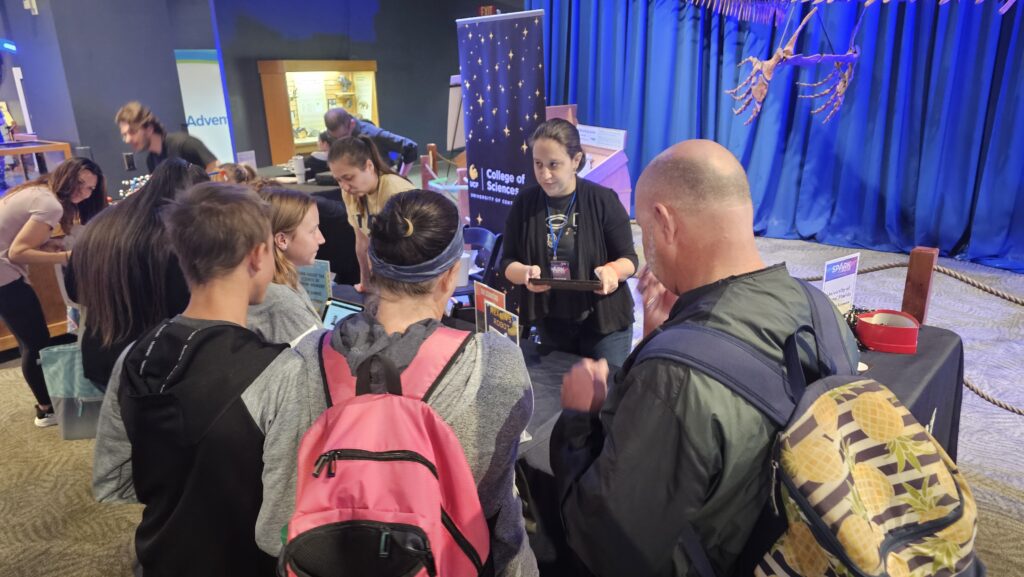
At the next table, associate professor of chemistry Dr. Yulia Gerasimova and her team set up a large, colorful DNA exhibit, “Visualizing DNA.” Visitors enhanced their understanding of DNA by folding origami or extracting DNA from a strawberry using dyes. Visitors could also take home their experiment in a souvenir necklace to remember the experience.
Gerasimova says it’s important for visitors to see that STEM isn’t intimidating or out of reach, and that engaging with it can be fun.
“We have so many talented young people, but they are stigmatized by the perceived difficulty of STEM,” she says, “but it’s not as challenging as they think; they can do it.”
The final day of Spark STEM Fest started with the return of “UCF to the Moon” and ended with a presentation from the Department of Biology called “Where Art Meets Marine Biology,” which focused on the ecosystem of the Indian River Lagoon, an estuary on the East Coast of Florida.
Visitors contributed to a large board representing the lagoon by coloring cutouts of its plants and animals. They also decorated oyster shell necklaces to take home.
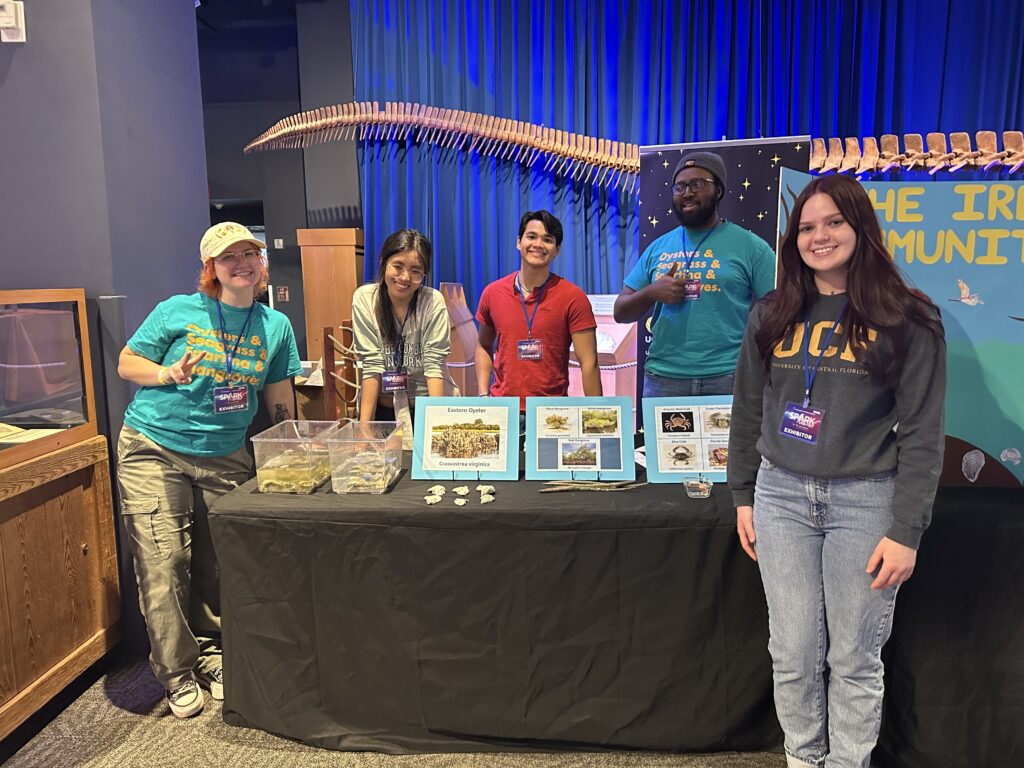
“Pictures say a lot more than words can,” says Meagan Pack, a biology student. “Having kids work together to make one big picture of the community within the Indian River Lagoon can help them understand what kind of life is found there.”
Through hands-on activities and interactive exhibits, the College of Sciences showed curious minds of all ages that STEM can be both engaging and approachable. Events like Spark STEM Fest help bridge the gap between the perceived difficulty of STEM and the reality of how accessible it is, giving future scientists the confidence to explore and experiment.