Biography
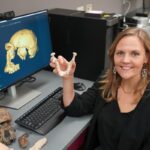
Dr. Freidline is a biological anthropologist specializing in paleoanthropology. Her research focuses on the evolution and development of human craniofacial morphology, with particular emphasis on how patterns of growth and development shape human craniofacial form. She applies advanced virtual anthropology methods to study craniofacial form, internal bone structure, and growth-related variation in fossil hominins, including Homo erectus, H. neanderthalensis, and H. sapiens.
Dr. Freidline directs a virtual anthropology laboratory focused on the digital study of human and fossil skeletal variation. Her research integrates geometric morphometrics, micro-CT imaging, surface histology, bone modeling analysis, and virtual fossil reconstruction. These approaches allow her to examine craniofacial shape at multiple scales, from broad patterns of facial and mandibular form to microscopic evidence of bone growth and remodeling. Her current research focuses especially on Middle and Late Pleistocene fossils from North Africa.
Dr. Freidline’s collaborative research has been published in leading journals, including Nature and Nature Communications. Recent projects include work on ~770,000-year-old fossil evidence from Thomas Quarry I in Morocco and a new virtual reconstruction of the DAN5 cranium from Gona, Ethiopia, which contributes to ongoing debates about the complex emergence and evolution of Homo erectus.
Dr. Freidline also supervises master’s and doctoral research across a broad range of topics in biological anthropology, with a primary focus on paleoanthropology—including hominin growth and taxonomy—as well as bioarchaeology and forensic anthropology.
She received her Ph.D. in 2012 through joint work at the City University of New York Graduate Center and the Max Planck Institute for Evolutionary Anthropology in Leipzig, Germany. From 2012 to 2020, she was a postdoctoral researcher in the Department of Human Evolution at the Max Planck Institute for Evolutionary Anthropology.