
UCF Anthropologist Examines Culture and Identity Through the Food We Eat
Through research spanning the Philippines and the United States, UCF anthropologist and department chair Ty Matejowsky examines how food and restaurants can reveal deeper meanings about culture, identity and human interaction.
Written by: Emily Dougherty | Published September 18, 2026
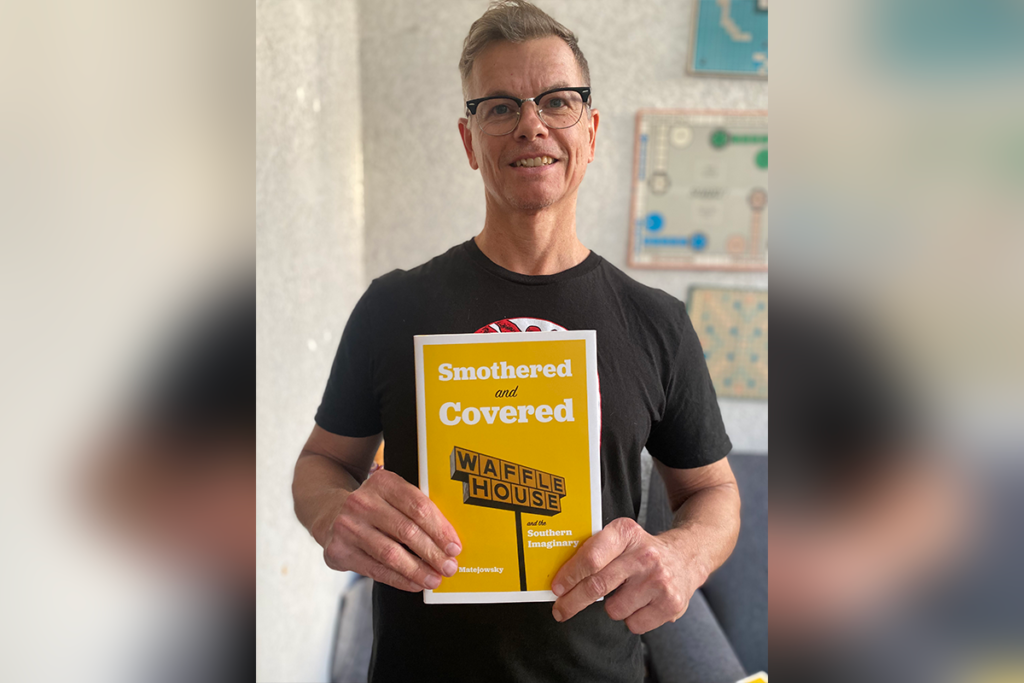
For most people, a trip to a fast-food restaurant is simply a meal. For Ty Matejowsky, chair of the Department of Anthropology, it can be an opportunity to understand much more about what it means to be human.
Matejowsky has spent decades examining food and restaurants as windows into human behavior, practices and identity. His research has taken him from the Philippines to the United States, where he examines how familiar food and dining experiences can reflect broader cultural patterns. His work has resulted in three books that explore different aspects of food, restaurants and culture, including Risqué Business, which examines Hooters and it place in American culture.

Although his subjects vary, Matejowsky sees a common thread running through his work: restaurants are familiar places where people interact, make choices and assign meaning to everyday experiences.
“Anthropology is interested in all aspects of what it means to be human, both in the past and the present,” Matejowsky says.
Food is an essential part of human life, but what people eat, how they eat and where they eat can reveal much more than individual preferences.
“It tells us a lot about social status, background, level of sophistication and more,” Matejowsky says.
Restaurants are also places where private and public life intersect. Matejowsky describes them as “third spaces,” where people gather and interact while participating in something as familiar as eating a meal.
For an anthropologist, those ordinary interactions can provide insights into the deeper meanings people attach to food and dining.
Globalization and the movement of culture
Matejowsky’s research into fast food began in part with his interest in how food connects to larger processes of globalization.
In his research on the Philippines, he examined how institutions, practices and cultural beliefs associated with the Global North and Western societies can move into other parts of the world, where they are received, understood and adapted to local tastes and practices.
Jollibee provides one example.

“It was influenced a lot by McDonald’s, and then it became a representation of the Philippines,” Matejowsky says.
Now, Jollibee is expanding into the United States, including a location around the corner from UCF’s main campus on East Colonial Drive in Orlando.
For Matejowsky, that trajectory illustrates how cultural influences can move in multiple directions. Ideas and practices that originate in one part of the world be adapted elsewhere and eventually take on new cultural meanings of their own.
Why Waffle House became Southern
His research on Waffle House examines how cultural associations can shape identify.
Although Waffle House is widely recognized as a symbol of the South, he notes that the company itself does not necessarily promote that association.
“Waffle House as a company didn’t put that idea out there,” he says. “Instead, the association has developed through the way people understand the restaurant and its place within regional culture.”
That distinction became central to Smothered and Covered, where Matejowsky explores Waffle House as a way to understand the cultural ideas and associations connected to the American South.
He points out that other companies that originated in the same region, including Walmart, Home Depot, Coca-Cola and Krispy Kreme, are generally not understood in the same way as specifically Southern brands.
For Matejowsky, that raises questions about why some companies become associated so strongly with a particular place and identity while others transcend those associations.

His research also examines how restaurants can reflect ideas about social interaction and identity. Rather than focusing solely on what is served, he considers how the design, atmosphere and social expectations surrounding restaurants can shape people’s experiences.
The different subjects allow him to examine how restaurants can carry meanings that are not necessarily stated outright but are understood by the people who visit them.
“There’s kind of these understood ideas about these restaurants,” Matejowsky says. “So I’m trying to deconstruct those understandings to really get at why these restaurants don’t articulate those ideas.”
Food as connection and boundary
Matejowsky’s work also examines how food can both connect people and establish cultural boundaries.
Because food is something people physically experience, he says it can provide a way of sharing and communicating aspects of a culture. Eating another culture’s food can demonstrate an appreciation or willingness to connect with others.
At the same time, certain foods can distinguish members of one community from those outside it.
Matejowsky points to balut, a Filipino delicacy consisting of a developing duck egg, as an example. While it is strongly associated with the Philippines, some people outside the culture find it difficult to eat.
For someone who does try it, he says the experience can carry meaning beyond simply tasting something new, representing a willingness to engage with a culture that may initially feel unfamiliar.
Making anthropology familiar
Matejowsky has also used food to make anthropology more available to students.
He previously taught a course called “Anthropology of Fast Food,” using familiar restaurants and food experiences to introduce concepts such as globalization, symbols and rituals.
Students could draw from their own experiences, including visits to familiar restaurant chains while traveling abroad, to consider how those restaurants changed from one location to another.
For Matejowsky, those everyday experiences are valuable precisely because they are familiar.
“To be able to understand what it means to be human across various contexts, you have to look at where people are, what they’re doing and what they’re thinking,” he says.
That perspective extends beyond the classroom and into Central Florida, which Matejowsky describes as a place where people from different parts of the country and world encounter one another.
“Central Florida really is an interesting place where you have all these different kinds of influences merging and influencing each other,” Matejowsky says.
Those encounters create opportunities to observe how people, experiences and cultural influences interact in everyday life.
Across his research, Matejowsky continues to find that some of the most familiar parts of everyday life can provide a deeper understanding of humanity.
“Food is such an ordinary part of our lives that we don’t always stop to think about what it really tells us,” he says. “But when you look at it closely, it can offer a really interesting way of understanding the people and cultures it’s a part of.”