
UCF Researcher Helps Define the Future of Nanozymes in Healthcare and Technology
A new study co-led by a UCF researcher highlights how nanozymes — engineered nanomaterials that mimic enzymes — could improve disease detection, targeted therapies and technologies designed for harsh for real-world environments.
Written by: Emily Dougherty | Published: June 1, 2026

Associate Professor of Chemistry Xiaohu Xia is exploring the potential of nanozyme technology in outperforming natural enzymes, proteins that accelerate chemical reactions.
The study was published in the journal Nature Reviews Materials. The first author is Shikuan Shao, a postdoctoral researcher at UCF, and Xia is a corresponding author.
The work is a collaboration with researchers from the University of New South Wales, the University of Massachusetts Amherst and UCF. Xia led UCF’s contributions and played a central role in coordinating the effort.
Solving the Limits of Natural Enzymes
Scientists have long relied on natural enzymes — proteins that accelerate chemical reactions — in medicine, environmental monitoring and industrial technologies. But despite their efficiency, natural enzymes are fragile and can lose effectiveness when exposed to heat, chemicals or long-term storage conditions.
Xia says this limitation motivated his early work in the field.
“The problem I wanted to solve was simple but important: how can we use nanozymes to overcome the limitations of natural enzymes in detecting disease earlier and more accurately?” Xia says.
Nanozymes provide a potential solution by replacing biological materials with engineered nanomaterials. Built at the nanoscale, nanozymes mimic enzyme function while offering greater stability and flexibility.
Because nanozymes can generate stronger catalytic signals, they allow researchers to detect extremely low levels of disease markers earlier and more reliably.
Technology Driving Design and Discovery
Researchers can adjust nanozymes’ size, shape and chemical composition to influence how they behave as catalysts.
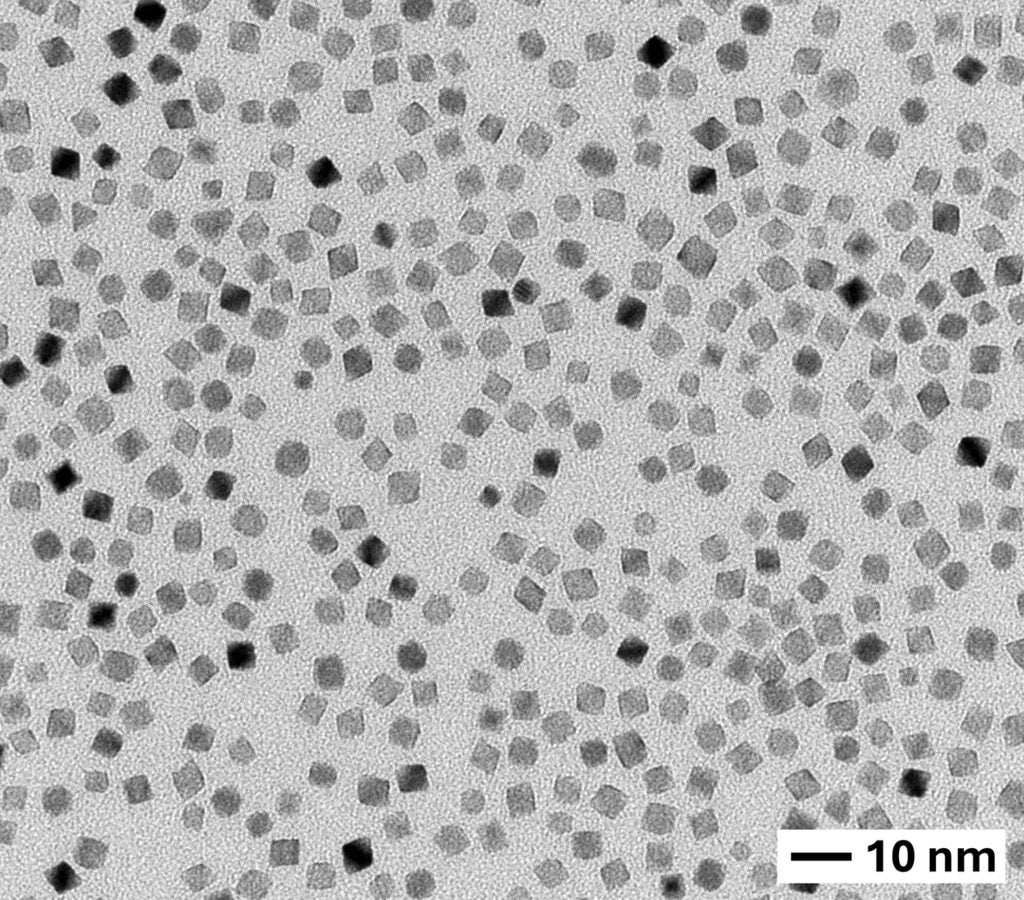
Equally critical are the technologies used to study them. At UCF, advanced imaging tools such as the Thermo Fisher Talos F200X analytical transmission electron microscope allow researchers to examine nanozymes at the atomic level and study how their structure determines their function.
“This kind of capability is extremely powerful because it lets us directly see how these materials are built, and connect their structure to their function,” Xia says.
Expanding Capabilities in Medicine and Beyond
Because nanozymes are engineered rather than naturally occurring, researchers can design them to perform functions beyond what biological enzymes typically can.
In medical applications, nanozymes can be designed to activate drugs only at specific disease sites, such as tumors. In this approach, a nanozyme can remain inactive as it moves through the body and become active only under certain conditions, converting an inactive or “masked” drug into its therapeutic form exactly where it is needed.
“This gives us very precise control over where and when a reaction happens,” Xia says. “It makes treatment much more targeted, so we can reduce side effects on healthy tissues while improving the effectiveness of therapy.”
Researchers also see applications beyond healthcare, including breaking down pollutants in wastewater systems, improving biofuel-related energy conversion and detecting pathogens in plants and animals.

From the Lab to the Real World
A key advantage of nanozymes is their durability. Unlike natural enzymes, they can withstand high temperatures, harsh chemical environments and long storage periods without losing activity.
Looking ahead, Xia says one of the most important next steps is moving nanozymes from laboratory research into practical and industrial use.
He says artificial intelligence is expected to play a major role in this transition by helping researchers navigate the nanonzyme design possibilities and better understand how structure influences function.
“We are beginning to see how they can go beyond replacing enzymes and instead enable entirely new functions that biology cannot achieve,” Xia says.
Some of the most exciting possibilities lie in extreme environments. The durability of nanozymes may also make them useful in environments too extreme for conventional biological systems. Xia says nanozymes could help produce oxygen or extract water in space, supporting life-support systems beyond Earth.
As research continues, scientists see nanozymes not only as replacements for natural enzymes, but as a powerful platform for building technologies that operate where biology cannot.
Funding from this study includes National Institutes of Health (R01 EB035519) and the U.S. Department of Agriculture (2024-67021-42829) support.